

Accounts receivable is the money customers owe you for work already done. Here’s what it is, why it’s an asset, how to measure it, what’s normal for your industry, a collection policy you can copy and a free calculator.
Every time you finish a job and send an invoice instead of collecting on the spot, you make your customer a short-term loan. No interest, no collateral, and often no follow-up until the money is overdue. Add up those loans and you have your accounts receivable, usually one of the largest assets your business owns.
Below is what accounts receivable is, why it counts as an asset, how it moves through your books, how to measure it, what’s normal for your industry, a collection policy you can copy, and a free calculator that shows how much cash is sitting in your unpaid invoices right now.
Receivables are also the biggest part of most service businesses’ working capital, the cushion that pays for growth.
Quick answer
Accounts receivable (AR) is money customers owe your business for work already done or goods already delivered but not yet paid for. It’s a current asset on the balance sheet, recorded when you invoice under the accrual method, and it turns into cash when the customer pays, usually within 30 to 90 days.
Key facts
Accounts receivable is a current asset; accounts payable is a current liability.
Days sales outstanding = receivables ÷ annual credit sales × 365.
Receivables average 27.5% of sales in engineering and construction and 12.4% across non-financial U.S. companies (NYU Stern, Jan. 2026).
50% of small employer firms reported uneven cash flow, including collecting receivables, as a challenge (Fed SBCS 2026).
Business bad debts are deductible only if the amount was included in gross income (IRS Topic 453).

What is accounts receivable?
Accounts receivable (AR) is the money customers owe your business for work you’ve already done or products you’ve already delivered but haven’t been paid for yet. It’s recorded as a current asset on the balance sheet because you expect to collect it as cash, usually within 30 to 90 days.
Receivables only show up if you keep your books on the accrual method. The IRS explains that “under an accrual method of accounting, you generally report income in the year it is earned,” not when the cash arrives (IRS Publication 538). So the moment you invoice, revenue goes up on your P&L and accounts receivable goes up on your balance sheet. Cash-basis books skip the receivable and record the sale only when the customer pays.
That’s why a business can show a strong month on paper and still struggle to make payroll. The profit is real, but until the customer pays, it’s sitting in receivables, not in the bank. We explain this gap in why profitable businesses still run out of cash.

Is accounts receivable an asset?
Yes. Accounts receivable is a current asset because it’s money owed to you that you expect to collect within a year. Accounts payable is the opposite: money you owe suppliers, recorded as a current liability. Your receivables are someone else’s payables.
The SEC’s guide to financial statements defines current assets as “things a company expects to convert to cash within one year” (SEC: Beginners’ Guide to Financial Statements). Customer invoices fit that definition, which is why receivables sit near the top of the balance sheet, right after cash.
An asset is only as good as its chance of being collected, though. A $40,000 invoice to a customer who has already gone quiet isn’t worth $40,000. That’s why accountants review receivables by age and set aside an allowance for the ones that probably won’t be paid. For a side-by-side look at both sides of the ledger, see accounts payable vs accounts receivable.
How does accounts receivable work?
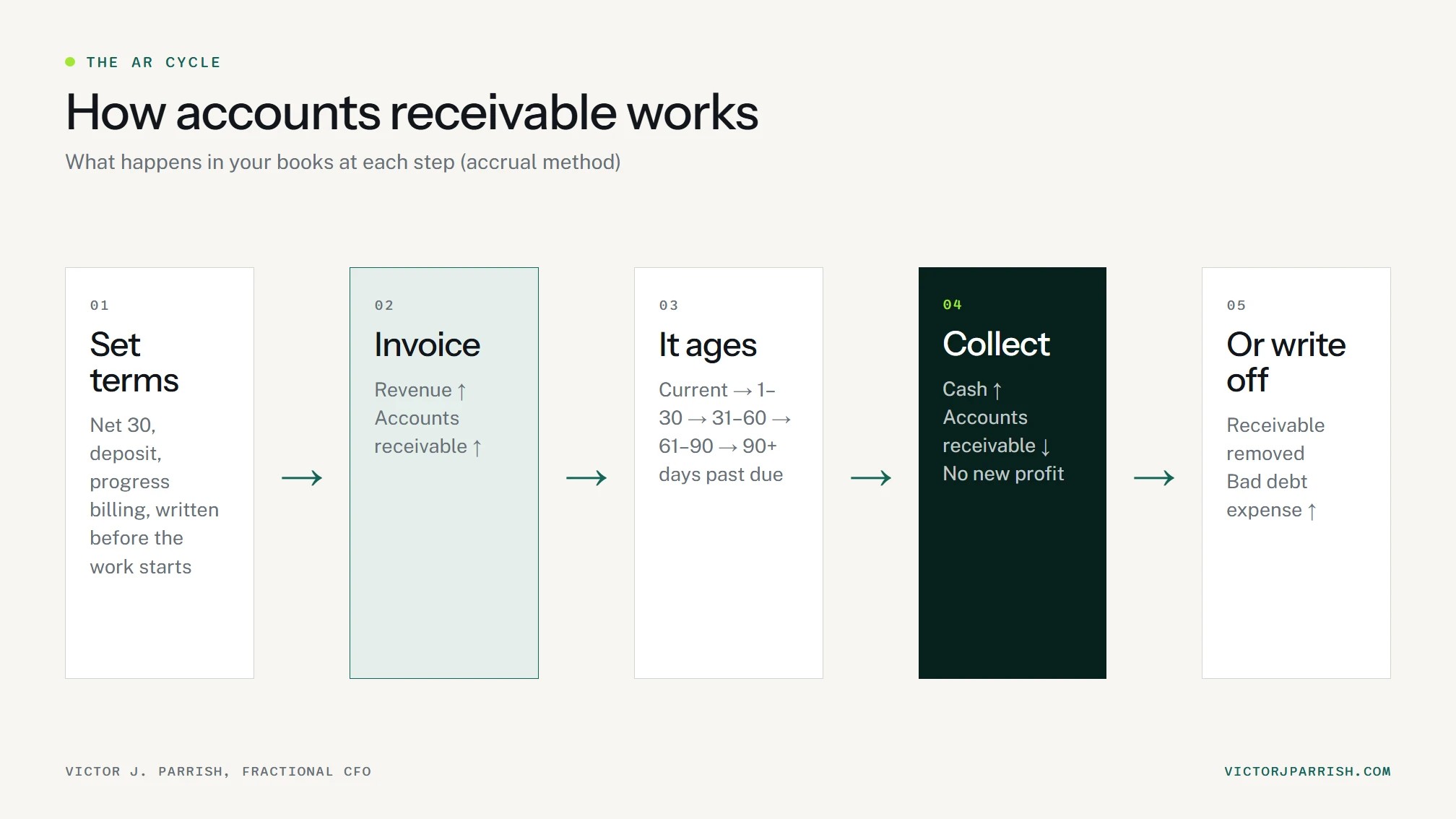
Accounts receivable follows a simple cycle: you agree on payment terms, do the work, send an invoice, and record the amount as revenue and a receivable. When the customer pays, cash goes up and the receivable goes down. If they never pay, the balance is eventually written off as a bad debt.
Set terms before the work. Net 30 means the full amount is due 30 days after the invoice date. Put it in the contract or estimate, not just on the invoice.
Invoice. Revenue and accounts receivable both go up by the invoice amount.
Wait. The invoice ages: current, 1 to 30 days past due, 31 to 60, 61 to 90, then over 90.
Collect. Cash goes up, accounts receivable goes down by the same amount. Revenue doesn’t change; you already recorded it.
Or write it off. If it becomes uncollectible, the receivable is removed and the loss is recorded as a bad debt expense.
Notice what doesn’t happen in step 4: collecting cash doesn’t create profit. All the profit was booked in step 2. Collection is purely about turning a promise into money you can spend.
Why are unpaid invoices really a loan to your customers?
Because you’ve already paid for the labor, materials and overhead to do the work, and the customer keeps that money until they pay you. If you cover the gap with a line of credit or a credit card, you’re paying interest so your customer doesn’t have to.
Take a service business with $1.8 million a year in invoiced sales and $240,000 in receivables. That’s about 49 days of sales waiting to be collected. If its terms are net 30, customers are paying about 19 days late on average. Those extra 19 days add up to roughly $92,000 of sales that customers are holding past your terms at any given time, and financing that on an 11% line of credit costs about $10,000 a year.
Cash timing is one of the most common small business problems. In the Federal Reserve’s 2026 survey of small employer firms, 50% reported uneven cash flow, including collecting receivables, as a financial challenge. Among firms with financial challenges, 54% used the owners’ personal funds to deal with them (Federal Reserve Banks: 2026 Report on Employer Firms). In other words, owners often finance their customers out of their own pockets.
How much cash is stuck in your receivables?
Enter your annual invoiced sales and today’s receivables balance. The calculator shows your days to collect, how much cash you’d free by hitting a collection target, what customers paying past your terms costs you in interest, and how much of the balance is at risk.
How much cash is stuck in your receivables?
Enter last year’s invoiced sales and what customers owe you today. See your days to collect, the cash a faster collection target would free, and what slow payers cost you.
Customers pay about 19 days after your terms. If you borrow to cover that gap at 11%, it costs about $10,126 a year. $28,800 is more than 90 days old; the older an invoice gets, the harder it is to collect.
DSO = receivables ÷ (annual credit sales ÷ 365). Estimates for planning only; your accountant can calculate these from your monthly balances.
In the example above, getting from 49 days to 35 days would free about $67,000, once, without a single new sale. That’s often more cash than a business would get from a small loan, and it doesn’t come with a payment.

How do you measure accounts receivable?
Track three numbers every month: days sales outstanding (receivables ÷ annual credit sales × 365), accounts receivable turnover (annual credit sales ÷ average receivables) and the aging report, which splits your balance into current, 1 to 30, 31 to 60, 61 to 90 and over 90 days past due.
Days sales outstanding (DSO) tells you how long it takes to get paid, in days. Compare it with your terms: a DSO of 49 on net 30 terms means customers pay about 19 days late.
AR turnover tells you how many times a year you collect your average balance. $1.8 million ÷ $240,000 = 7.5 times. Our guide to the accounts receivable turnover ratio shows how to calculate and improve it.
The aging report tells you which invoices to chase first. Watch the over-90 column: the older an invoice gets, the less likely it is to be paid in full.
Put DSO and the over-90 total on your KPI dashboard and review them in the same meeting every month. A number nobody looks at doesn’t improve.
How much accounts receivable is normal for your industry?
It varies widely. In NYU Stern’s January 2026 data on U.S. companies, receivables average about 27.5% of annual sales in engineering and construction (roughly 100 days), 18.4% in business and consumer services (67 days) and 12.4% across all non-financial companies (45 days).
Industries that bill after the work is done, especially on contracts with progress billing and retainage, carry the largest balances. Restaurants and retailers, which get paid at the register, carry almost none. The chart below uses Professor Aswath Damodaran’s working capital dataset (NYU Stern: Working Capital Ratios by Sector). Tap your industry to see what its average would mean at your revenue.
How much of a year’s sales is still unpaid, by industry
Accounts receivable as a share of annual sales for U.S. public companies. Tap an industry to see what that means at your revenue.
Source: Aswath Damodaran, NYU Stern, “Working Capital Ratios by Sector (US),” January 2026. Public-company averages; small businesses vary widely. Days = % of sales × 365.
These are public-company averages, so treat them as a reference point, not a target. A small contractor can and should collect much faster than a national engineering firm with government clients. If you’re well above your industry, the gap is cash you’ve earned and can’t use yet.

How do you collect accounts receivable faster?
Collect deposits up front, invoice the day the work is done, make paying easy, send a reminder before the due date, call at 7 days late, pause new work at 30 days late and escalate at 60. A written collection policy, applied the same way to every customer, does most of the work.
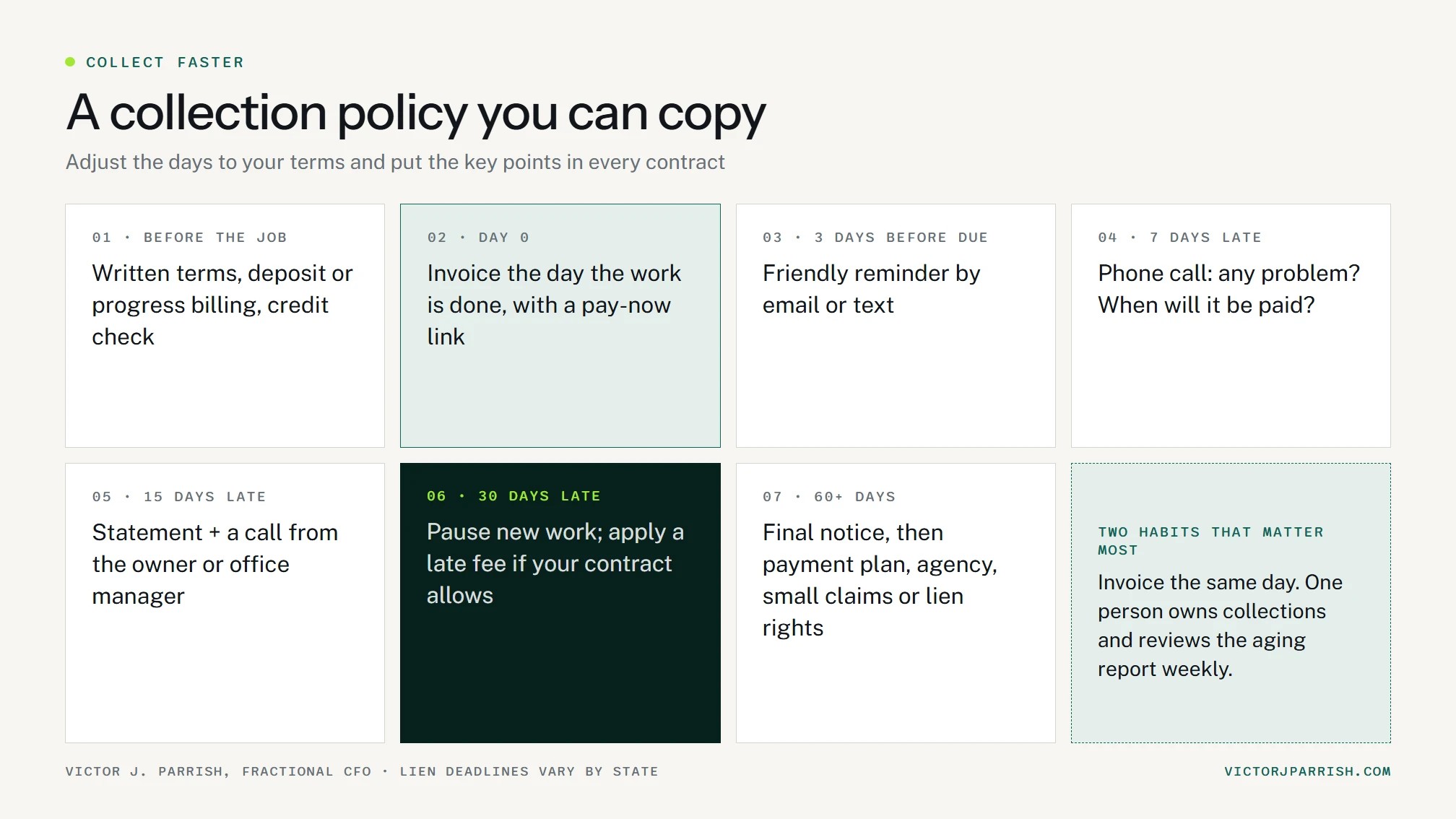
Here’s a collection policy you can copy. Adjust the days to your terms, and put the key points in every contract or estimate so nothing comes as a surprise:
Before the job: written terms, a deposit or progress billing on larger jobs, and a credit check for new commercial customers.
Day 0: invoice the day the work is finished, with the due date, a clear description and a pay-now link.
3 days before due: a friendly reminder by email or text.
7 days late: a phone call. Ask whether there’s a problem with the invoice and when payment will be sent.
15 days late: a statement plus a second call from the owner or office manager.
30 days late: no new work until the account is current, and any late fee your contract allows.
60 days and beyond: a final written notice, then your escalation options: a payment plan, a collection agency, small claims court, or, for contractors, lien rights. Lien deadlines vary by state and can be short, so ask an attorney early.
Two habits matter more than any template. First, invoice immediately; every day an invoice sits in a drawer is a day added to your DSO. Second, make one person responsible for collections and review the aging report with them every week.
Carlos R. runs a marketing and multi-service business in New Jersey, the kind of company that bills clients after the work is done. When he wanted capital to grow, his file already showed the other side of the receivables habit: net-30 vendor accounts and a Paydex score of 80, the business credit score that measures how promptly you pay your own suppliers. After the applications were sequenced and utilization kept under 30%, he secured $58,000 in business funding, led by a $30,000 PNC business line of credit he can draw on and repay as needed. A line like that won’t fix slow collections, but it keeps a late client from turning into a missed payroll.
What happens if a customer never pays?
After reasonable collection efforts, you write the invoice off as a bad debt. If you use the accrual method and already reported the invoice as income, you can usually deduct the bad debt. If you use the cash method, you never reported the income, so there’s nothing to deduct.
The IRS is specific about this: “You may deduct business bad debts, in full or in part, only if the amount you were owed is included in your gross income in the current or prior year.” It also says that to show a debt is worthless, “you must establish that you’ve taken reasonable steps to collect the debt,” though you don’t have to go to court if a judgment would be uncollectible (IRS Topic 453: Bad debt deduction). A documented collection policy is your evidence.
Writing off a receivable doesn’t get the cash back. It only recognizes that the asset was worth less than the balance sheet said. The cheapest bad debt is the one you prevent with deposits, clear terms and fast follow-up.
Should you factor or borrow against your receivables?
Only if you’ve already tightened collections and still need the cash sooner. Factoring sells your invoices at a discount, and a receivables-based line of credit borrows against them. Both cost money, so compare the fee with what slow collections already cost you before signing.
For seasonal or contract-driven businesses, the SBA offers CAPLines through its lenders. The Seasonal CAPLine, for example, “finances the seasonal increases of accounts receivable and inventory” (SBA: Types of 7(a) loans). Lenders will look at your aging report, so clean receivables also make you easier to finance. Our guide to qualifying for a business loan covers what else they check.
Sources
These are the primary sources used for the figures in this article.
U.S. Securities and Exchange Commission: Beginners’ Guide to Financial Statements
Aswath Damodaran, NYU Stern: Working Capital Ratios by Sector (US), January 2026
Federal Reserve Banks: Small Business Credit Survey, 2026 Report on Employer Firms
U.S. Small Business Administration: Types of 7(a) loans (CAPLines)
This article is general education, not accounting, tax or legal advice. Talk to your CPA about how these rules apply to your business.
FAQ
Frequently asked questions
What is accounts receivable?
Accounts receivable is the money customers owe a business for goods or services already delivered but not yet paid for. It’s recorded as a current asset on the balance sheet when the business uses the accrual method of accounting.
Is accounts receivable an asset or a liability?
Accounts receivable is an asset, specifically a current asset, because it’s money owed to the business that it expects to collect within a year. Accounts payable, the money a business owes its suppliers, is the liability.
What is the difference between accounts receivable and accounts payable?
Accounts receivable is money customers owe you; accounts payable is money you owe suppliers. Receivables are a current asset and payables are a current liability. One company’s receivable is another company’s payable.
How do you calculate days sales outstanding?
Divide your accounts receivable balance by annual credit sales, then multiply by 365. For example, $240,000 of receivables on $1.8 million of credit sales is about 49 days. Compare the result with your payment terms.
Can I deduct an unpaid invoice as a bad debt?
Only if the amount was included in your gross income, which generally means you use the accrual method. The IRS also requires you to show you took reasonable steps to collect. Cash-method businesses never reported the income, so there’s no deduction.


