

A bookkeeper records what happened, an accountant makes it right and handles taxes, and a CFO decides what happens next. Here’s what each does, what each costs (BLS data), and the right order to hire them.
Most owners build their finance team in the order problems show up. The tax bill surprises them, so they hire an accountant. The accountant complains about the books, so they hire a bookkeeper. Years later, cash is still tight and no one can say why, because nobody was ever hired to look forward.
A bookkeeper, an accountant and a CFO each answer a different question about your money. Below is what each one does, what each costs according to federal wage data, the order most service businesses should add them in, the signs you’ve outgrown the first two, and a free decision tool that tells you who to hire next.
One example of why the forward-looking layer matters: operating cash flow, the number your banker checks first, comes straight from your books but rarely gets reviewed until someone owns the plan.
Quick answer
A bookkeeper records transactions and reconciles accounts so the books are accurate. An accountant reviews those books, prepares financial statements and handles taxes. A CFO uses the numbers to plan ahead: cash forecasts, pricing, budgets and financing. Hire a bookkeeper first, then a CPA, then a fractional CFO as you grow.
Key facts
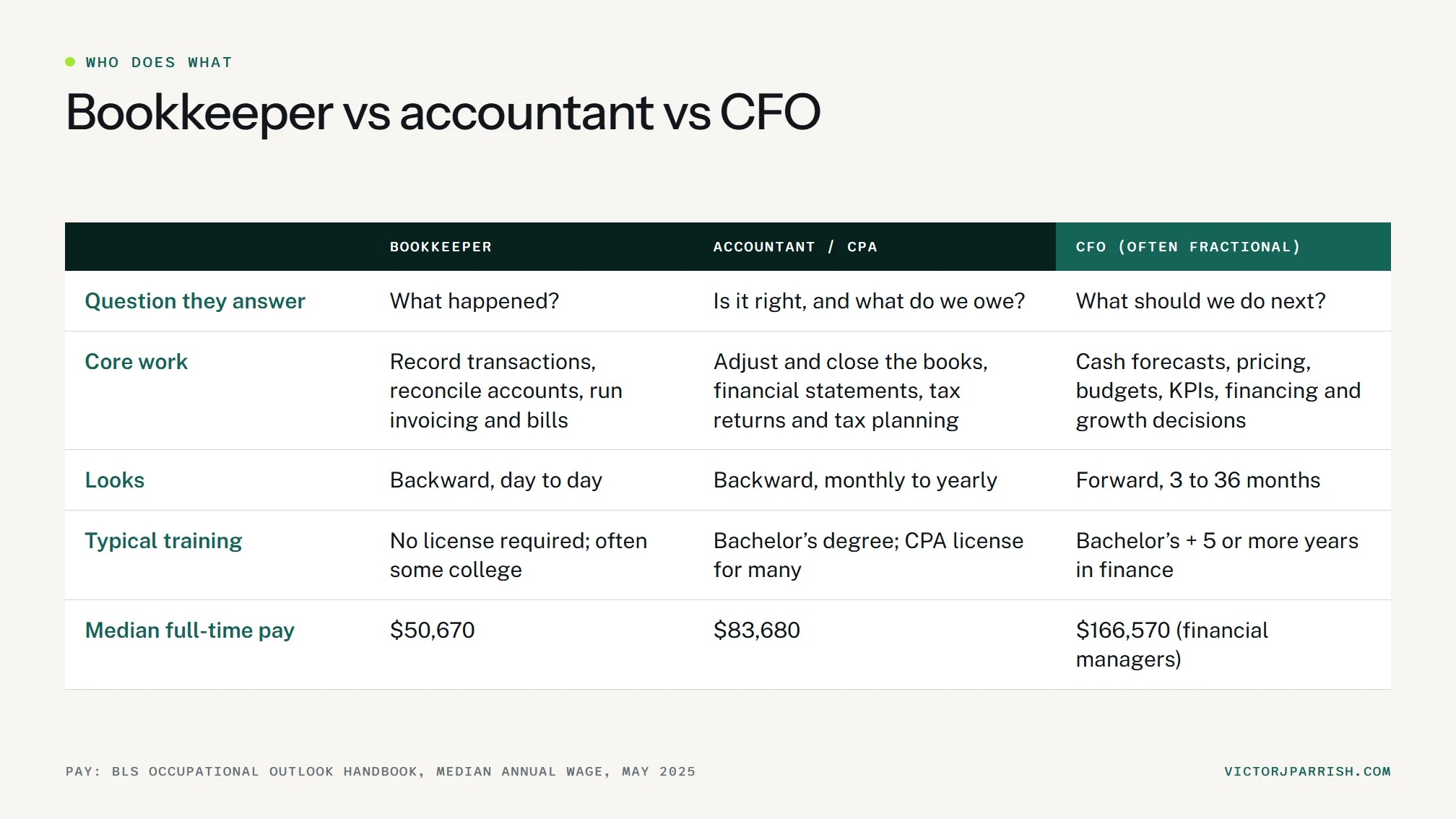
Median pay, May 2025 (BLS): bookkeeping clerks $50,670; accountants and auditors $83,680; financial managers $166,570.
Wages are 70.0% of private-industry employer compensation costs, so add about 43% for benefits (BLS ECEC, June 2026).
CPAs, enrolled agents and attorneys have unlimited representation rights before the IRS.
BLS projects bookkeeping clerk jobs to fall 6% and financial manager jobs to grow 10% from 2025 to 2035.
50% of small employer firms reported uneven cash flow as a financial challenge (Fed SBCS 2026).

What is the difference between a bookkeeper, an accountant and a CFO?
A bookkeeper records what happened: every sale, bill and payment, reconciled to the bank. An accountant checks that record, turns it into financial statements and handles taxes. A CFO uses those numbers to decide what happens next, through cash forecasts, pricing, budgets and financing. Bookkeepers and accountants look back; a CFO looks ahead.
Think of it as three layers. Bookkeeping is the data. Accounting is the data made correct and compliant. CFO work is the data turned into decisions. Each layer depends on the one below it, which is why the order you hire in matters more than the titles.
The roles overlap at the edges. Many accountants also do bookkeeping, and a good bookkeeper will flag problems an accountant would catch. But one person rarely does all three well, because the skills, training and pay are very different, as the comparison below shows.
What does a bookkeeper do?
A bookkeeper records and categorizes every transaction, reconciles bank and credit card accounts, sends invoices, tracks what customers owe, enters bills and keeps payroll records. The output is a clean set of books and a monthly profit and loss statement you can trust.
The Bureau of Labor Statistics describes bookkeeping, accounting and auditing clerks as workers who “compute, classify, and record data to help organizations keep complete and accurate financial records” (BLS Occupational Outlook Handbook). No license is required, and a bookkeeper doesn’t need to be a CPA.
Don’t underrate the job. The IRS lists what good records do for you: “monitor the progress of your business, prepare your financial statements, identify sources of income, keep track of deductible expenses” and support what you report on your tax return (IRS: Recordkeeping). If the books are late or wrong, your accountant and any CFO are working from bad data. A reliable monthly close is what makes your profit and loss statement worth reading.
What does an accountant or CPA do, and what’s the difference between a bookkeeper and a CPA?
An accountant reviews and adjusts the books, prepares financial statements, and handles tax returns and tax planning. A CPA is an accountant licensed by a state board. Unlike a bookkeeper, a CPA can represent you before the IRS on any matter, including audits, collections and appeals.
BLS sums the role up in one line: accountants and auditors “prepare and examine financial records,” and most need a bachelor’s degree (BLS: Accountants and auditors). In a small business, that usually means a monthly or quarterly review of the books, year-end adjustments, the tax return, and planning decisions like whether an S corp election saves you money.
The credential matters when the IRS calls. Per the IRS, “enrolled agents, certified public accountants, and attorneys have unlimited representation rights before the IRS” and can represent clients on audits, payment and collection issues, and appeals (IRS: Understanding tax return preparer credentials). A preparer with no credential has limited rights or none. If taxes are the main reason you’re hiring, a CPA or enrolled agent is the right call, not a bookkeeper.

What does a CFO do that an accountant doesn’t?
A CFO is responsible for where the business is going, not just where it’s been. That means a 13-week cash flow forecast, budgets, pricing and margin analysis, KPIs, financing and big decisions like hiring or buying equipment. An accountant tells you what you earned and owe; a CFO tells you what to do about it.
BLS groups CFOs with financial managers. Controllers “direct the preparation of financial reports that summarize and forecast an organization’s financial position,” and experienced financial managers may advance to become CFOs, who are “responsible for the accuracy of an organization’s financial reporting” (BLS: Financial managers). Most need a bachelor’s degree and at least five years of experience in another business or financial occupation.
In a small business, the CFO role is usually part time. A fractional CFO works a few days a month, runs a monthly financial review with you, keeps the cash forecast current and sits in on pricing and financing decisions. Our guide to what a fractional CFO actually does covers a typical engagement.
How much does a bookkeeper, an accountant and a CFO cost?
Based on BLS data for May 2025, median annual pay is $50,670 for bookkeeping clerks, $83,680 for accountants and auditors and $166,570 for financial managers, the group that includes controllers and CFOs. Benefits add about 43% on top, so a full-time CFO-level hire costs roughly $238,000 a year.
The 43% comes from the BLS Employer Costs for Employee Compensation survey: in June 2026, wages and salaries were 70.0% of private-industry employers’ compensation costs and benefits were the other 30.0% (BLS: Employer Costs for Employee Compensation). Dividing a salary by 0.70 gives a fair estimate of what the hire really costs you. Switch the chart below between wage, cost to employ and monthly cost, and compare each role with your revenue.
What a full-time bookkeeper, accountant and CFO cost
Median pay from the Bureau of Labor Statistics, and what that salary costs once benefits are added. Tap a bar for details.
Sources: U.S. Bureau of Labor Statistics, Occupational Outlook Handbook, median annual wage May 2025 and projections 2025–35. Cost to employ divides the wage by 0.70 because wages and salaries were 70.0% of private-industry employer compensation costs in June 2026 (BLS ECEC). CFO pay is usually above the financial-manager median.
Outsourced bookkeeping, a CPA firm and a fractional CFO are billed for the hours you use, which is why most businesses under $10 million fill these seats part time. Pay attention to the outlook column too: BLS projects bookkeeping clerk jobs to fall 6% from 2025 to 2035, as software takes over data entry, while financial manager jobs grow 10%. Automation is shrinking the record-keeping layer and increasing the value of the judgment layer.

Which should you hire first: a bookkeeper, an accountant or a CFO?
Hire in this order: a bookkeeper first, so the books close every month; a CPA or enrolled agent second, to plan taxes during the year; then a fractional CFO once revenue passes about $1 million, cash gets tight, or you plan to borrow. Hiring a CFO before the books are clean wastes the CFO’s time on cleanup.
The most common mistake is the reverse order: an owner hires a CPA for taxes, lets the books slide all year, and pays the CPA’s hourly rate to rebuild twelve months of transactions in March. The second most common is stopping at the accountant and treating the tax return as the financial plan.
Who should you hire next?
Answer up to five yes-or-no questions. The tree stops at the first gap in your finance team.
Median annual wage (BLS, May 2025) divided by 0.70, because wages are 70% of private-industry employer compensation costs (BLS, June 2026). Outsourced and fractional help is billed for the hours you use, usually a fraction of these figures.
Revenue isn’t the only trigger. A $600,000 contractor with three crews, retainage and a bank line can need CFO-level help sooner than a $2 million consultancy with steady retainers. Complexity, growth rate and debt matter as much as size.

What are the signs you need a CFO, not just a bookkeeper and accountant?
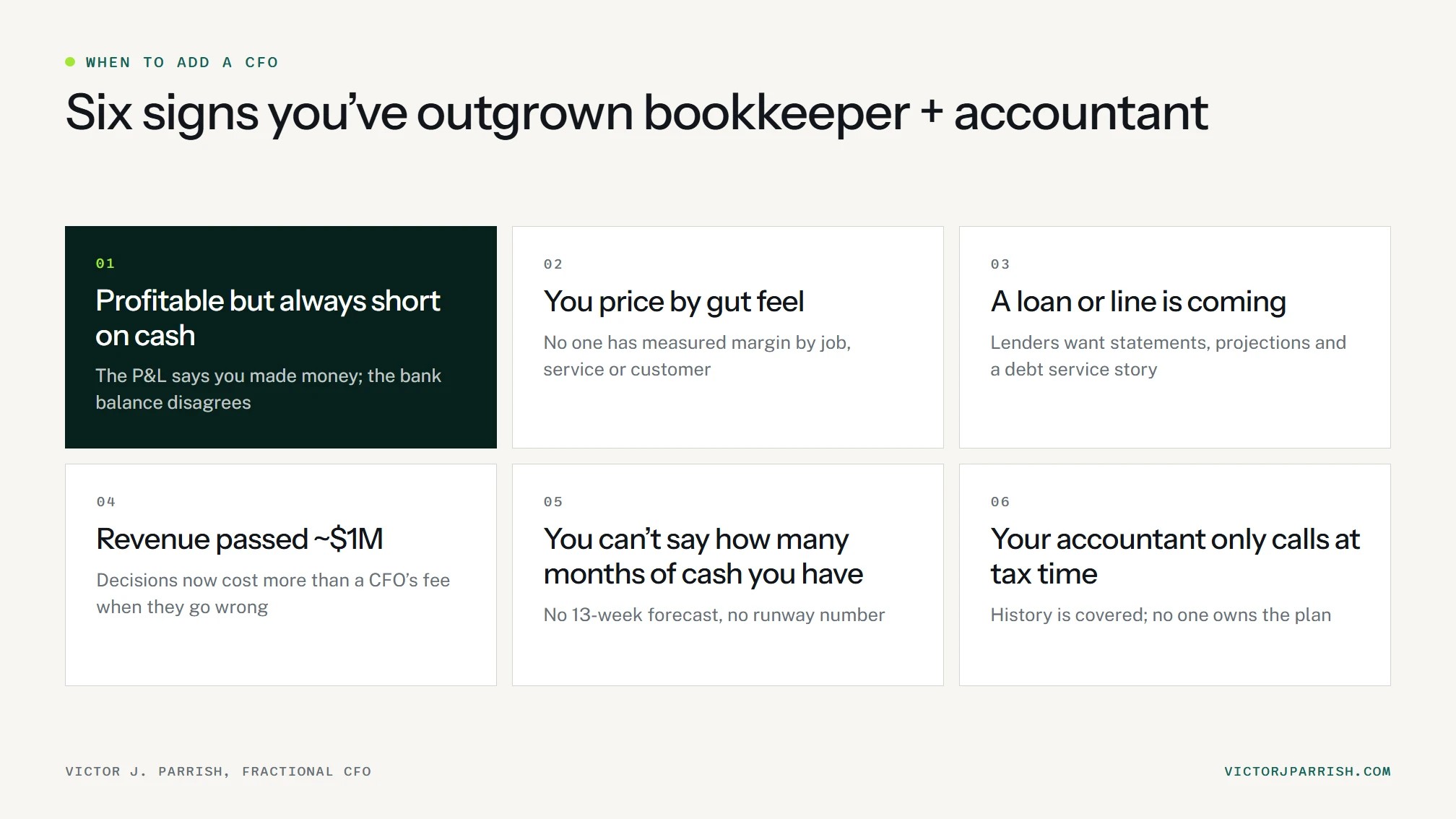
You need CFO-level help when you’re profitable but short on cash, you can’t say how many months of cash you have, you price jobs by feel, a loan or line of credit is coming up, or revenue has passed about $1 million and each decision costs more to get wrong.
Cash pressure is the clearest signal. In the Federal Reserve’s 2026 survey of small employer firms, 50% reported uneven cash flow as a financial challenge, and among firms with challenges, 54% covered them with the owners’ personal funds (Federal Reserve Banks: 2026 Report on Employer Firms). A bookkeeper records that pattern and an accountant explains it at year-end. Fixing it in the month it happens is CFO work.
Albert C. owns a home care business in Georgia. His scores were in the 700s, but his cards carried heavy balances, some above 80% of their limits, and he had $10,000 to $15,000 available to pay them down. Instead of spreading that money evenly, the plan set a payment for every card, with the projected utilization after each one, and moved the largest balance to a 0% business card rather than paying it off in cash. The targeted paydown totaled $14,399. He then secured $108,000 in new business funding, including a $60,000 U.S. Bank business loan.
That’s the difference in one example. A bookkeeper would have recorded the balances accurately. Deciding which dollars go where, and in what order, to change the outcome is the job of a CFO.
Is a bookkeeper enough for a small business?
A bookkeeper is enough on its own only for very small, simple businesses, and even then you need a CPA or enrolled agent for the tax return. Once you have employees, inventory, job costing or debt, add an accountant who reviews the books and plans taxes during the year.
A useful test: if your bookkeeper sends you a P&L each month and you don’t know what to do differently after reading it, the books are fine. What’s missing is the next layer.
Can one person be your bookkeeper, accountant and CFO?
Sometimes, at the very small end, but it’s rarely a good idea past the first few years. The skills differ, a single person has no one checking their work, and paying CFO rates for data entry is expensive. Most growing businesses use an outsourced bookkeeper, a CPA firm and a fractional CFO who work from the same books.
What matters is that the three layers talk to each other: the bookkeeper closes on a schedule, the accountant reviews the close, and the CFO turns it into a KPI dashboard and a plan. If you’re planning to borrow, that combination is also what a lender wants to see; our guide to qualifying for a business loan explains why.
Sources
These are the primary sources used for the figures in this article.
U.S. Bureau of Labor Statistics: Accountants and auditors (Occupational Outlook Handbook)
U.S. Bureau of Labor Statistics: Financial managers (Occupational Outlook Handbook)
U.S. Bureau of Labor Statistics: Employer Costs for Employee Compensation, June 2026
IRS: Understanding tax return preparer credentials and qualifications
Federal Reserve Banks: Small Business Credit Survey, 2026 Report on Employer Firms
This article is general education, not accounting, tax or legal advice. Talk to your CPA about how these rules apply to your business.
FAQ
Frequently asked questions
What is the difference between a bookkeeper and an accountant?
A bookkeeper records daily transactions, reconciles accounts and keeps the books current. An accountant reviews and adjusts those books, prepares financial statements and tax returns, and plans taxes. Bookkeepers don’t need a license; many accountants hold a CPA license.
Do I need a bookkeeper or an accountant first?
Most small businesses need a bookkeeper first, so transactions are recorded and reconciled every month, plus a CPA or enrolled agent to file the tax return. Add an accountant for year-round review and tax planning once you have employees, inventory, job costing or debt.
Is a CFO the same as an accountant?
No. An accountant focuses on accurate records, financial statements and taxes, which describe the past. A CFO uses those numbers to plan the future: cash forecasts, budgets, pricing, KPIs and financing. Small businesses usually hire a fractional, part-time CFO.
How much does a bookkeeper, accountant and CFO make?
According to the Bureau of Labor Statistics, the May 2025 median annual wage was $50,670 for bookkeeping, accounting and auditing clerks, $83,680 for accountants and auditors, and $166,570 for financial managers, the group that includes controllers and CFOs.
Can a bookkeeper represent me in an IRS audit?
Not unless they hold a credential. The IRS says enrolled agents, certified public accountants and attorneys have unlimited representation rights, including audits, collections and appeals. Preparers without one of those credentials have limited rights or none.


