

Gross profit margin shows whether your pricing covers the cost of the work. Here’s the formula, what belongs in cost of goods sold for a service business, 2026 benchmarks by industry and a calculator to check yours.
Gross profit margin tells you how much of every sales dollar is left after paying for the work itself. It’s the first number to check when you’re busy but broke, because it shows whether your pricing covers your direct costs before rent, office staff and your own salary take their share.
It’s also the margin owners most often get wrong. Field labor booked as overhead, materials left on the truck, or a tax return that skips cost of goods sold entirely can make your gross margin look far better, or worse, than it really is. Here’s the formula, what belongs in it, and what’s normal for your industry.
Quick answer
To calculate gross profit margin, subtract cost of goods sold (materials, direct labor, subcontractors and other job costs) from revenue, divide the result by revenue and multiply by 100. $600,000 of revenue and $390,000 of direct costs gives $210,000 of gross profit, a 35% gross margin.
Key facts
Gross profit margin = (revenue − COGS) ÷ revenue × 100.
US public companies outside finance average a 34.4% gross margin; engineering and construction 15.5% (Damodaran, Jan 2026).
Residential remodelers averaged 29.9% gross and 6.3% net in 2024; home builders 20.7% gross in 2023 (NAHB).
The IRS lets service businesses skip COGS on the tax return, which can make gross margin meaningless for pricing.
A 35% markup only yields a 26% margin; for a 35% margin, divide cost by 0.65.

How do you calculate gross profit margin?
Subtract cost of goods sold (COGS) from revenue to get gross profit, then divide gross profit by revenue and multiply by 100. A contractor with $600,000 of revenue and $390,000 of materials, field labor and subcontractor costs has $210,000 of gross profit, a 35% gross profit margin.
The gross profit margin formula, step by step:
Start with revenue for the period, net of refunds and discounts.
Add up cost of goods sold: materials, direct labor and the payroll taxes on it, subcontractors and any other cost tied directly to delivering the work.
Gross profit = revenue − COGS.
Gross profit margin = gross profit ÷ revenue × 100.
Calculate it monthly and for each job, not just once a year. The annual number tells you how the year went. Job-level margins tell you which work to chase. Pull the figures straight from your profit and loss statement, and make sure the cost lines are set up the way the next section describes.
What goes into cost of goods sold for a service business?
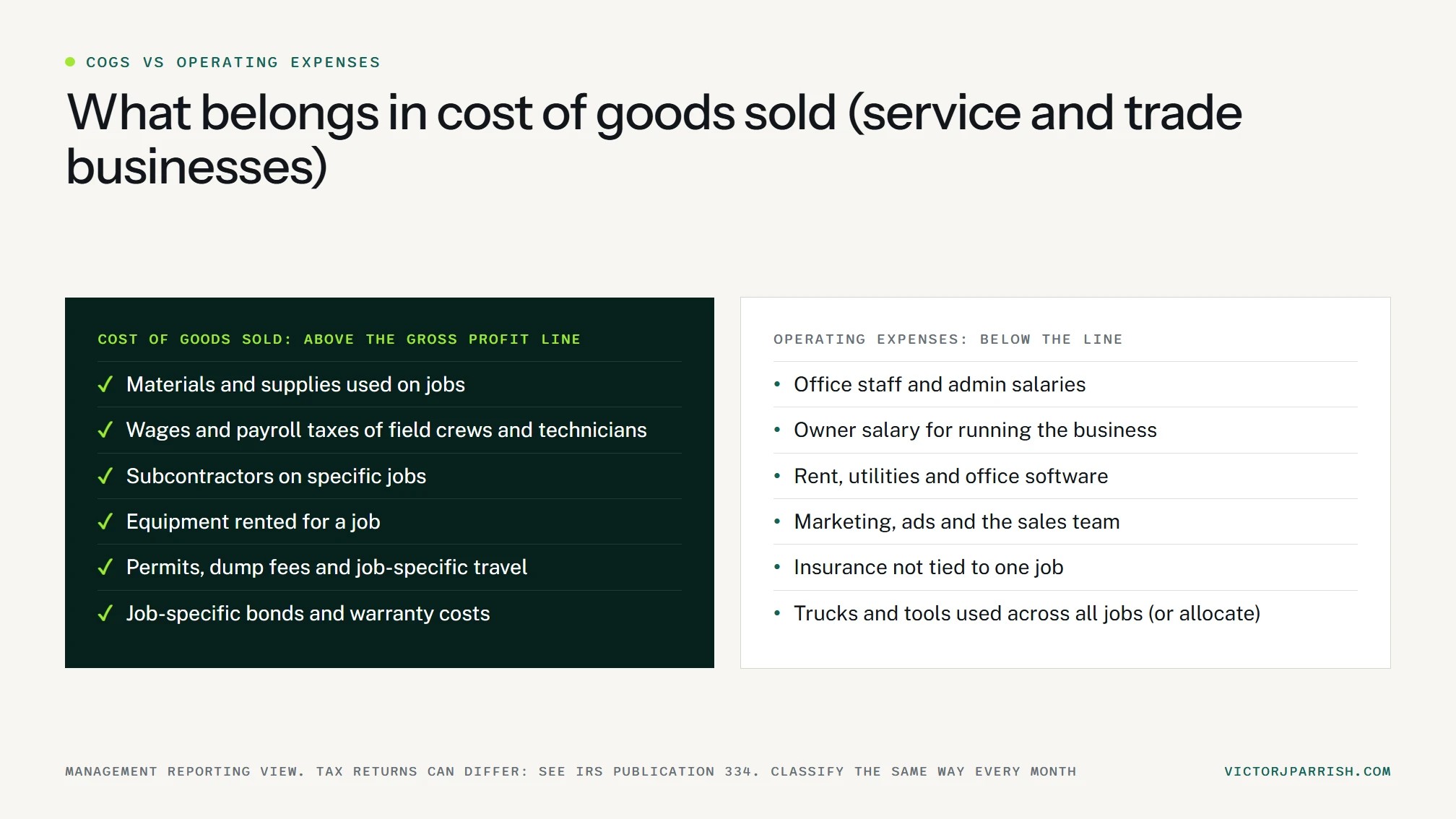
For a service or trade business, cost of goods sold should include every cost that rises and falls with the work: job materials, wages and payroll taxes for field crews, subcontractors, equipment rented for specific jobs, permits and job-specific travel. Office salaries, rent, marketing and the owner’s management pay belong in operating expenses below the gross profit line.
This is where most margins go wrong, and the tax return is often the cause. For tax purposes, the IRS says businesses that sell services rather than products can figure gross profit directly from net receipts, without calculating cost of goods sold at all (IRS Publication 334). For corporations and partnerships that do report it, Form 1125-A is the cost of goods sold schedule (IRS: About Form 1125-A). A tax return built that way can show a 100% gross margin for a roofing company, which is useless for pricing.
For management reporting, set up your chart of accounts so direct costs sit above the line. The three most common mistakes we see:
Field labor in “payroll expense.” Crew wages buried in overhead inflate gross margin and hide jobs that lose money on labor.
Materials expensed when bought, not when used. A big supply run in March and a light one in April makes both months’ margins wrong.
Changing the rules month to month. Trucks, tools and small equipment can go either way. Pick one treatment and stick with it, or the trend line means nothing.

What is a good gross profit margin?
A good gross profit margin depends on your industry. Across US public companies outside finance, the average is about 34%. Residential remodelers averaged 29.9% in 2024, home builders 20.7% in 2023, and engineering and construction firms about 15%. Software companies run above 70%.
The public-company figures come from Professor Aswath Damodaran’s January 2026 margin data: business and consumer services averaged 33.4%, building materials 30.9%, homebuilding 22.7%, trucking 21.2% and engineering and construction 15.5% (Damodaran, NYU Stern: Margins by sector). For small contractors, the National Association of Home Builders’ surveys are closer to home. Remodelers reported a 29.9% average gross margin in 2024 and a 6.3% net margin (NAHB: Remodelers’ Cost of Doing Business Study). Builders reported 20.7% gross and 8.7% net for 2023, the highest gross margin in the survey since 2006 (NAHB: Builders’ Cost of Doing Business Study).

Treat benchmarks as a range, not a target. A specialty trade with high-skill labor should beat a general contractor that subs out most of its work, and a firm that books field labor correctly will show a lower margin than one that doesn’t.
What’s the difference between gross profit margin and net profit margin?
Gross profit margin subtracts only the direct cost of the work. Net profit margin subtracts everything: direct costs, overhead, interest and taxes. Gross margin tells you whether your pricing works; net margin tells you whether the whole business works. Remodelers keep about 30 cents of gross profit per dollar but only about 6 cents of net.
Read them together. A strong gross margin with a weak net margin means overhead is too heavy for your volume. A weak gross margin means the problem is in pricing, estimating or field productivity, and no amount of overhead cutting will fix it. Our guide to net profit margin covers the bottom-line version and industry benchmarks.
Does cheaper financing improve your gross profit margin?
Financing changes what a business pays to carry its debt, which shows up in net margin, not gross margin. A 13-year-old California print shop we worked with added $67,400 in business credit to move high-interest card balances toward 0% offers and fund equipment. Whether that equipment pays off depends on what it does to gross margin.
Jose R. has owned a printing and graphics business since 2010. His personal scores were in the 810s and 820s, but his business cards were carrying 46–72% utilization on large balances, and he had four Experian inquiries in the past 12 months. He wanted to move his card debt to 0% interest and raise about $150,000 for equipment and software, so we set a realistic first-round target of $50,000–$75,000.
The plan used balance transfers and new 0% limits to pull balances off the high-interest cards, with new applications at Elan, Bank of America, U.S. Bank and Goldman Sachs placed in order. He secured $67,400 in new business credit, inside the target. Read Jose’s full case study.
Here’s where gross margin comes in. Card interest sits below the gross profit line, so moving it to 0% improves net margin and cash, not gross margin. New equipment is different: it raises gross margin only if it cuts the materials, labor or outsourcing on each job, or lets you charge more. For illustration, if a new machine cuts the direct cost of a $2,000 job from $1,300 to $1,150, gross margin on that job rises from 35% to 42.5%. Run the calculator below on the jobs a purchase will produce before you finance it. If the margin doesn’t move, the financing is only a cheaper way to carry the same margin.

Why is your gross margin lower than you think?
Gross margin usually comes in lower than owners expect because of unbilled change orders, labor hours that overrun the estimate, material waste and price increases between bid and purchase, and because pricing uses markup on cost instead of margin on price. A 35% markup only produces a 26% gross margin.
That last point catches a lot of contractors. Markup is profit divided by cost; margin is profit divided by price. If you want a 35% gross margin, divide your cost by 0.65 rather than multiplying by 1.35. A $12,000 job priced for a 35% margin should be about $18,460, not $16,200. Our markup vs margin guide has the conversion table.
Use the calculator below with a recent month or quarter. Compare the result with your industry, then price your next job for the margin you actually want.
Gross margin calculator
Use a month, a quarter or a year from your P&L. Put only direct job costs in cost of goods sold; office salaries, rent and marketing stay out.
Benchmarks: A. Damodaran, NYU Stern, US public companies, January 2026; NAHB Cost of Doing Business studies for builders and remodelers. Small private firms vary widely. Educational only.
How do you improve your gross profit margin?
Raise prices where you’re below market, estimate labor from your own job history, bill every change order, buy materials closer to the job, and stop taking work that consistently lands below your target margin. Track gross margin by job and by job type so you know which work to chase.
Price from margin, not markup. Set a target gross margin by job type and calculate price from it.
Close the change-order gap. Get every change signed and priced before the work is done.
Compare estimate to actual on every job. Labor overruns are the most common margin leak in the trades.
Drop or reprice your worst job type. Most businesses have one category of work that drags the average down.
Review it monthly. Put gross margin on your monthly financial review next to cash and receivables.
Sources
These are the primary sources used for the figures in this article.
Aswath Damodaran, NYU Stern: Operating and net margins by industry sector (January 2026)
National Association of Home Builders, Eye on Housing: Remodelers saw profit margin gains in 2024
National Association of Home Builders, Eye on Housing: Builders’ profit margins improved in 2023
This article is general education, not accounting, tax or legal advice. Talk to your CPA about how these rules apply to your business.
FAQ
Frequently asked questions
What is the gross profit margin formula?
Gross profit margin = (revenue − cost of goods sold) ÷ revenue × 100. For example, $600,000 of revenue minus $390,000 of direct costs is $210,000 of gross profit, and $210,000 ÷ $600,000 is a 35% gross profit margin.
What is a good gross profit margin for a small business?
It depends on the industry. US public companies outside finance average about 34%. Residential remodelers averaged 29.9% in 2024 and home builders 20.7% in 2023, according to NAHB. Engineering and construction firms average about 15%, while software companies exceed 70%.
Is gross profit the same as gross margin?
No. Gross profit is a dollar amount: revenue minus cost of goods sold. Gross margin is that dollar amount as a percentage of revenue. $210,000 is gross profit; 35% is gross margin.
Does a service business have cost of goods sold?
For tax purposes, the IRS lets businesses that sell services figure gross profit from net receipts without calculating cost of goods sold. For managing the business, you should still track direct costs, such as field labor, materials and subcontractors, above the gross profit line so your margin means something.
What is the difference between gross margin and markup?
Margin is gross profit divided by price; markup is gross profit divided by cost. A 35% markup on a $12,000 cost gives a $16,200 price and only a 26% margin. To earn a 35% margin, divide cost by 0.65 for a price of about $18,460.


