

Net profit margin tells you how many cents of every sales dollar your business actually keeps. Here’s how to calculate it, 2026 benchmarks by industry, and what to do if yours is low.
Revenue gets the headlines, but net profit margin tells you how well the business actually works. It answers a simple question: out of every dollar a customer pays you, how many cents do you keep after every cost, including interest and taxes? Two businesses with the same revenue can have wildly different margins, and the one with the higher margin is usually the one with more options.
Quick answer
Net profit margin is net income divided by revenue, times 100: the share of every sales dollar a business keeps after all costs, interest and taxes. What counts as good depends on the industry. US public companies averaged 8.56% excluding financials in January 2026, with construction near 6% and software above 25%.
Key facts
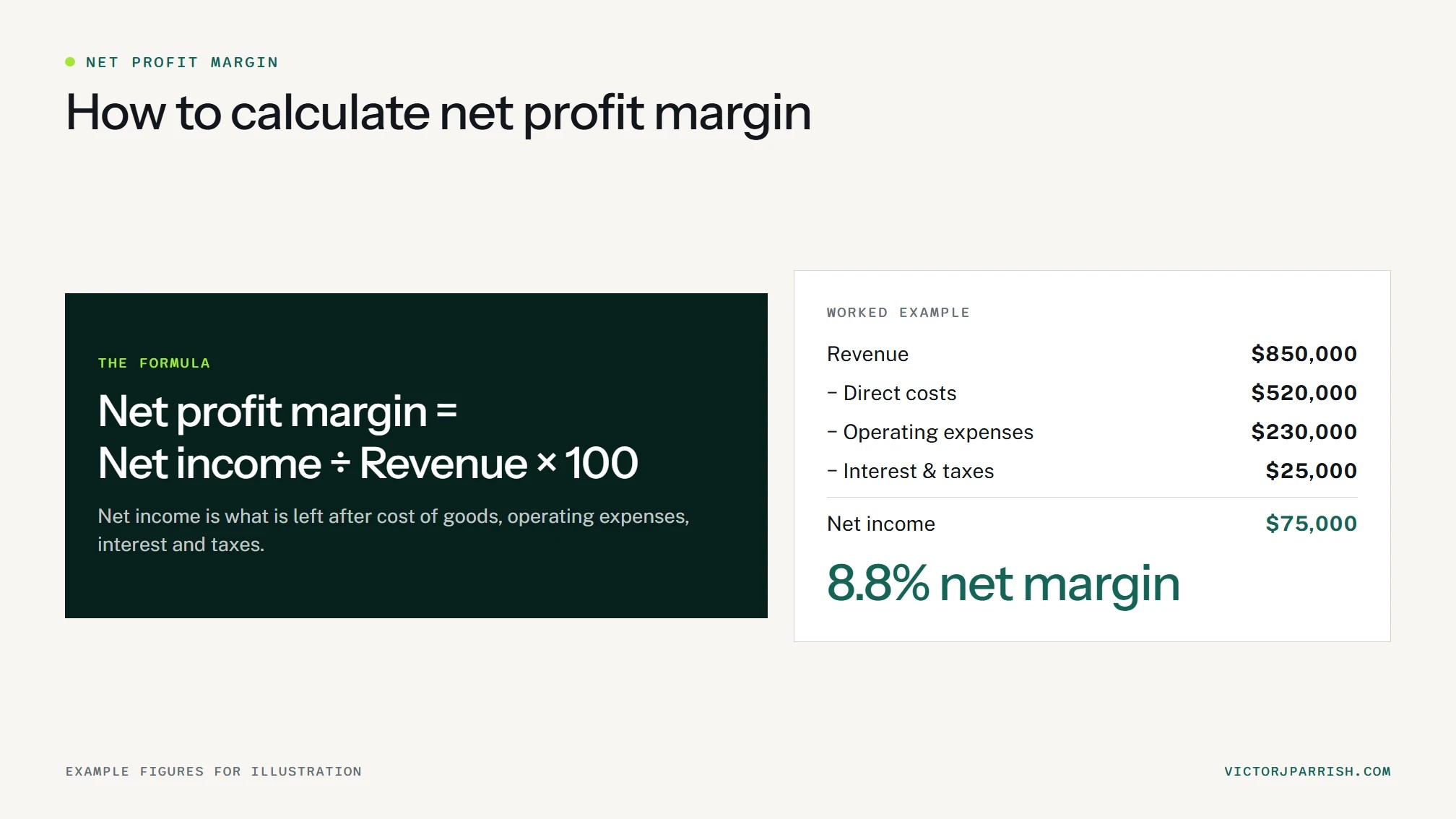
Net profit margin = net income ÷ revenue × 100.
US total market average (ex-financials): 8.56% net margin, January 2026 (Damodaran).
Engineering and construction averaged 5.94%; business and consumer services 7.03%.
Subtract a market-rate owner salary before comparing small business margins.
What is net profit margin?
Net profit margin is net income divided by revenue, expressed as a percentage. It shows how much of each sales dollar remains as profit after cost of goods sold, operating expenses, interest and taxes. A 10% net margin means the business keeps 10 cents of every dollar it brings in.
Net income is the bottom line of the income statement, the report that shows revenue earned over a period and the costs of earning it (SEC: Beginners’ Guide to Financial Statements). Margin turns that bottom line into a ratio you can compare across months, years and businesses of different sizes.
Because it is the last line of the P&L, net margin reflects everything: pricing, job costs, overhead, debt and tax planning. That makes it the best single measure of overall profitability, and the hardest one to fake.
How do you calculate net profit margin?
Subtract all expenses from revenue to get net income, then divide net income by revenue and multiply by 100. For example, a business with $850,000 of revenue and $75,000 of net income has a net profit margin of 8.8%. Use a full year of numbers to avoid seasonal swings.
Start with total revenue for the period.
Subtract cost of goods sold or direct job costs to get gross profit.
Subtract operating expenses to get operating income.
Subtract interest and taxes to get net income.
Divide net income by revenue and multiply by 100.
Many small businesses pay owners through draws rather than salary, which makes margins look better than they really are. If that’s you, subtract a market-rate salary for your own work before comparing your margin with anyone else’s. The calculator below does the math and compares your result with your industry.
Net profit margin calculator
Enter a year of numbers from your P&L to see your gross, operating and net margin, and how you compare with your industry.
You are 2.9 points above
To reach 10% at today’s revenue you need $85,000 of net profit: $10,000 more from higher prices or lower costs.
Benchmarks: Aswath Damodaran, NYU Stern, “Margins by Sector (US),” data as of January 2026 (public companies). Small private firms often differ.

What is a good net profit margin by industry?
It depends heavily on the industry. In Aswath Damodaran’s January 2026 data on US public companies, average net margins range from about 1% in healthcare support services to over 25% in software, with the total market (excluding financial firms) at 8.56%. Compare yourself with your own industry, not with business in general.
Damodaran, a professor at NYU Stern, publishes margins by sector every January. A few relevant averages from the January 2026 update (Damodaran: Margins by Sector (US)):
Engineering / construction: 5.94%
Business and consumer services: 7.03%
Restaurants and dining: 9.37%
Retail (general): 5.61%
Trucking: 3.79%
Software: 25.49%
Total market excluding financials: 8.56%
These are large public companies, so treat them as a reference point rather than a target. Smaller firms often run thinner margins because they lack scale, or higher ones because the owner’s own labor isn’t fully priced in.

What is a good net profit margin for contractors and service businesses?
Contractors and trade businesses typically operate on thinner net margins than professional services, because materials and labor make up most of the cost of each job. The public-company average for engineering and construction is 5.94%, while service businesses that sell expertise can often sustain double-digit net margins with good pricing.
For contractors, net margin lives or dies at the job level. A few underpriced bids, unbilled change orders or labor overruns can wipe out a year of careful overhead control. That is why job costing, not the year-end P&L, is the real margin tool for construction businesses.
For consultants, agencies and other expertise-based firms, the biggest lever is utilization and pricing: how many hours are billed, and whether rates have kept up with costs.

Why is my net profit margin low?
Low net margins usually come from one of five places: underpricing, rising direct costs that weren’t passed on, overhead that grew faster than revenue, interest on expensive debt, or an owner salary that wasn’t budgeted for. A line-by-line look at the P&L, expressed as a percentage of revenue, usually shows which one it is.
Pricing: rates set years ago, or discounts that became the norm.
Direct costs: materials, subcontractors or labor that rose faster than prices.
Overhead creep: software, vehicles and staff added during a good year.
Debt costs: high-interest financing on equipment or working capital.
Owner pay: paying yourself more than the business earns, or not at all, which hides the real picture.

How can a small business improve its net profit margin?
The fastest levers are pricing and direct costs, because they affect every sale. Raise prices where you deliver more value, review job costs and supplier pricing, trim overhead that doesn’t drive revenue, and refinance expensive debt. Then track margin monthly so improvements stick instead of drifting back.
Review prices against current costs and competitors at least once a year.
Track gross margin by job, client or service line to find where you lose money.
Cut or renegotiate overhead that doesn’t support revenue.
Refinance or pay down high-interest debt.
Add margin to your monthly financial review so changes show up within weeks, not at tax time.
A small change compounds quickly: on $850,000 of revenue, moving from an 8.8% to a 10% net margin adds about $10,000 of profit a year without a single new customer.
How does owner pay affect net profit margin?
If you pay yourself through draws instead of a salary, your net profit margin is overstated, because the cost of your own labor never hits the P&L. Before comparing your margin with an industry benchmark, subtract a market-rate salary for the work you do. Otherwise a business can look healthy on paper while paying its owner below market.
The reverse also happens: an owner who runs personal expenses through the business or takes an oversized salary will show a margin that looks worse than the business really is. Lenders and buyers normalize for both, and you should too.
Getting this right also makes the conversation about how much to pay yourself far easier, because you can see exactly how much profit the business produces after a fair wage for your time.
What is the difference between gross, operating and net profit margin?
Gross margin measures profit after direct costs only. Operating margin also subtracts overhead. Net margin subtracts everything, including interest and taxes. Reading all three shows where profit is lost: weak gross margin points to pricing or job costs, while a big drop from operating to net margin points to debt or taxes.
Damodaran’s January 2026 data shows the pattern: the total US market had a 37.76% gross margin and a 9.74% net margin (Damodaran: Margins by Sector (US)). Most of what a business earns is consumed between the top and the bottom of the income statement, which is exactly why owners should watch all three.
Sources
These are the primary sources used in this article.
FAQ
Frequently asked questions
What is a good net profit margin for a small business?
There is no universal number, because margins vary by industry. As a reference, US public companies outside the financial sector averaged an 8.56% net margin in January 2026. Many healthy small businesses aim for roughly 7% to 10% or more, depending on the industry and how the owner is paid.
How do I calculate net profit margin?
Divide net income by total revenue and multiply by 100. Net income is revenue minus cost of goods sold, operating expenses, interest and taxes. For example, $75,000 of net income on $850,000 of revenue is an 8.8% net profit margin.
What is the difference between gross margin and net margin?
Gross margin subtracts only direct costs, such as materials and job labor, from revenue. Net margin subtracts every expense, including overhead, interest and taxes. Gross margin shows whether your pricing works; net margin shows what the business ultimately keeps.
What is the average profit margin for construction companies?
In Aswath Damodaran’s January 2026 data on US public companies, engineering and construction firms averaged a 5.94% net margin and homebuilders 9.47%. Smaller contractors vary widely, and margins depend heavily on job costing and change-order discipline.
Why is my net profit margin negative?
A negative net margin means expenses exceeded revenue for the period, so the business lost money. Common causes are underpricing, cost increases that weren’t passed on, overhead that grew faster than sales, or a one-time expense. Review each P&L line as a percentage of revenue to find the cause.


