

Free cash flow is the cash your business produces after paying for the equipment it needs. Here’s the formula, a worked contractor example, how it compares with net income, and a free calculator.
Revenue is what most owners watch, and profit is what their accountant talks about. The number that decides whether you can pay yourself, pay down debt or buy the next truck without stress is a third one: free cash flow.
Free cash flow is the cash your business produces from its work after paying for the equipment and other long-term assets it needs to keep going. A business can grow sales every year, show a healthy profit and still have little or no free cash flow. Below is the formula, a worked example from a roofing contractor, how it compares with net income and operating cash flow, how much companies in your industry reinvest, and a free calculator that runs the numbers for your business.
Free cash flow also decides how much you can draw without shrinking your owner’s equity, the part of the balance sheet that belongs to you.
Quick answer
Free cash flow is the cash a business generates from operations minus what it spends on equipment, vehicles, buildings and software. The formula is operating cash flow minus capital expenditures. Starting from the P&L: net income plus depreciation, minus growth in receivables and inventory, plus growth in payables, minus capital expenditures. It’s the cash left to pay debt, the owner or growth.
Key facts
Free cash flow = operating cash flow − capital expenditures.
Count financed equipment at full cost in the year bought; loan payments come later as principal.
US public companies outside finance spent about 1.45× depreciation on capex (Damodaran, Jan 2026).
For 2025, the Section 179 limit is $2.5 million, and 100% bonus depreciation returned for property acquired after Jan. 19, 2025 (IRS Pub 946).
50% of small employer firms reported uneven cash flow as a financial challenge (Fed SBCS 2026).

What is free cash flow?
Free cash flow (FCF) is the cash a business generates from its operations minus the money it spends on capital assets like equipment, vehicles, buildings and software. It’s the cash left over that the owner can use to pay down debt, take distributions, build reserves or fund growth without borrowing.
Free cash flow is built from two parts of the cash flow statement. The first section, operating activities, shows the cash the business brought in from its normal work. The second, investing activities, covers purchases of long-term assets. The SEC’s guide gives a simple example: when a company buys a piece of machinery, the cash flow statement shows it as an outflow from investing activities (SEC: Beginners’ Guide to Financial Statements). Free cash flow puts those two sections together.
Free cash flow isn’t a line on most small business reports, and generally accepted accounting principles (GAAP) don’t define it, so you’ll usually calculate it yourself. It answers a question your profit and loss statement can’t: after the business has kept its tools and trucks running, how much cash did it actually throw off?

What is the free cash flow formula?
The free cash flow formula is operating cash flow minus capital expenditures. If you don’t have a cash flow statement, start from net income, add back depreciation and amortization, subtract increases in receivables and inventory, add increases in payables, then subtract what you spent on equipment and other long-term assets.
Short version: FCF = operating cash flow − capital expenditures (capex).
Long version: FCF = net income + depreciation and amortization − increase in working capital − capital expenditures.
Working capital here means receivables plus inventory minus payables. If customers owe you more at year-end than at the start, that growth used cash, so it comes off.
Capital expenditures are the full cost of assets you bought in the period, whether you paid cash or financed them.
Count financed equipment at its full cost in the year you buy it. If a loan paid for a $60,000 truck, the truck is still a $60,000 capital expenditure, and the loan shows up separately as financing. That keeps free cash flow honest about what the business consumed. The loan payments come out later, which is why we also look at cash after debt and owner pay below.

How do you calculate free cash flow? A worked example
A roofing contractor with $1.4 million in revenue earned $126,000 of net income. Adding $38,000 of depreciation, subtracting $39,000 of net working capital growth and subtracting $85,000 of new equipment leaves $40,000 of free cash flow, about 2.9% of revenue, even though profit was 9%.
Start with net income: $126,000. That’s a 9% net margin, a solid year by most standards. Our net profit margin guide explains how it compares.
Add depreciation: +$38,000. Depreciation reduced profit but no cash left the bank for it this year.
Adjust for working capital: −$39,000. Sales grew, so receivables rose $42,000 and materials on hand rose $6,000, partly offset by $9,000 more owed to suppliers.
Operating cash flow: $125,000.
Subtract capital expenditures: −$85,000 for a new truck and a trailer.
Free cash flow: $40,000.
Now the owner’s side. The business repaid $24,000 of loan principal, which never appears on the P&L because only interest is an expense, and the owner took $60,000 in draws. Free cash flow covered less than half of that, so the bank balance fell $44,000 in a year with a $126,000 profit. Nothing went wrong in this example: the business grew and invested. But an owner who sets draws from the P&L instead of from free cash flow ends up here every year.

What’s the difference between free cash flow, net income and operating cash flow?
Net income measures profit, including non-cash expenses like depreciation. Operating cash flow measures the cash the core business brought in, after timing differences like slow-paying customers. Free cash flow goes one step further and subtracts the cash spent on equipment and other long-term assets, so it shows what’s truly available.
Each number answers a different question, and each can mislead you on its own. Net income ignores the customer who hasn’t paid yet; our guide to accounts receivable turnover shows how much cash slow collections can tie up. Operating cash flow ignores the truck you had to replace. Free cash flow is the strictest of the three, which is why lenders, buyers and investors look at it. When the three move apart, the gap tells you where the cash went, a pattern we cover in why profitable businesses still run out of cash.

How much do businesses spend on equipment compared with depreciation?
Across US public companies outside finance, capital spending ran about 1.45 times depreciation in Damodaran’s January 2026 data. Trucking and transportation spent about 1.5 times, engineering and construction 1.24 times, and business and consumer services only 0.65 times. When capex runs above depreciation, free cash flow will be lower than profit plus depreciation suggests.
Depreciation spreads an asset’s cost over its useful life, so in any given year it rarely matches what you actually spend. Equipment costs rise, fleets grow, and the replacement truck costs more than the one it replaces. Professor Aswath Damodaran of NYU Stern publishes these ratios every January for US public companies (Damodaran, NYU Stern: Capital expenditures by sector, January 2026). Pick your industry and your own yearly depreciation in the chart below to see the gap.
Equipment spending vs depreciation, by industry
For every $1 of depreciation on the P&L, how much companies actually spent on equipment and property. Past the 100% line, depreciation understates the cash going out.
Source: A. Damodaran, NYU Stern, capital expenditures by sector for US public companies, January 2026. Capital expenditures ÷ depreciation and amortization. Small private firms vary widely, and one big purchase can swing a single year.
Taxes can blur this further. For 2025, Section 179 lets a business deduct up to $2.5 million of qualifying equipment in the year it’s placed in service, and the One Big Beautiful Bill Act restored 100% bonus depreciation for qualified property acquired after January 19, 2025 (IRS Publication 946). Those rules can wipe out taxable income in a big equipment year. They don’t change the cash you spent. A large write-off can make the tax return look thin while free cash flow is negative, or the reverse in the years after, so keep the tax plan and the cash plan side by side.
How much free cash flow should a small business have?
There’s no single target, but a healthy service business usually converts a large share of its net income into free cash flow over a few years. Track free cash flow as a percentage of revenue and as a percentage of net income. If it runs well below profit year after year, look at collections, inventory and equipment spending.
Use the calculator below with last year’s numbers. Most of them come from your P&L and the change in your balance sheet from the start of the year to the end. It walks from net income to operating cash flow, free cash flow and the cash left after loan principal and owner draws, and shows each step on a bridge chart.
Free cash flow calculator
Start from your P&L, adjust for the cash that didn’t match it, subtract what you spent on equipment, and see what was really left for you.
Free cash flow = operating cash flow − capital spending. Count equipment at its full cost in the year you buy it, even if a loan paid for it; the loan shows up as principal payments afterward. A simplified indirect-method estimate; your cash flow statement is the final word.
Two ratios are worth watching. Free cash flow margin (FCF ÷ revenue) tells you how much of each sales dollar turns into spendable cash. Cash conversion (FCF ÷ net income) tells you how much of your profit was real money. One weak year is normal in a growth or equipment year. Three in a row is a pattern. Add both to your KPI dashboard and review them each quarter.
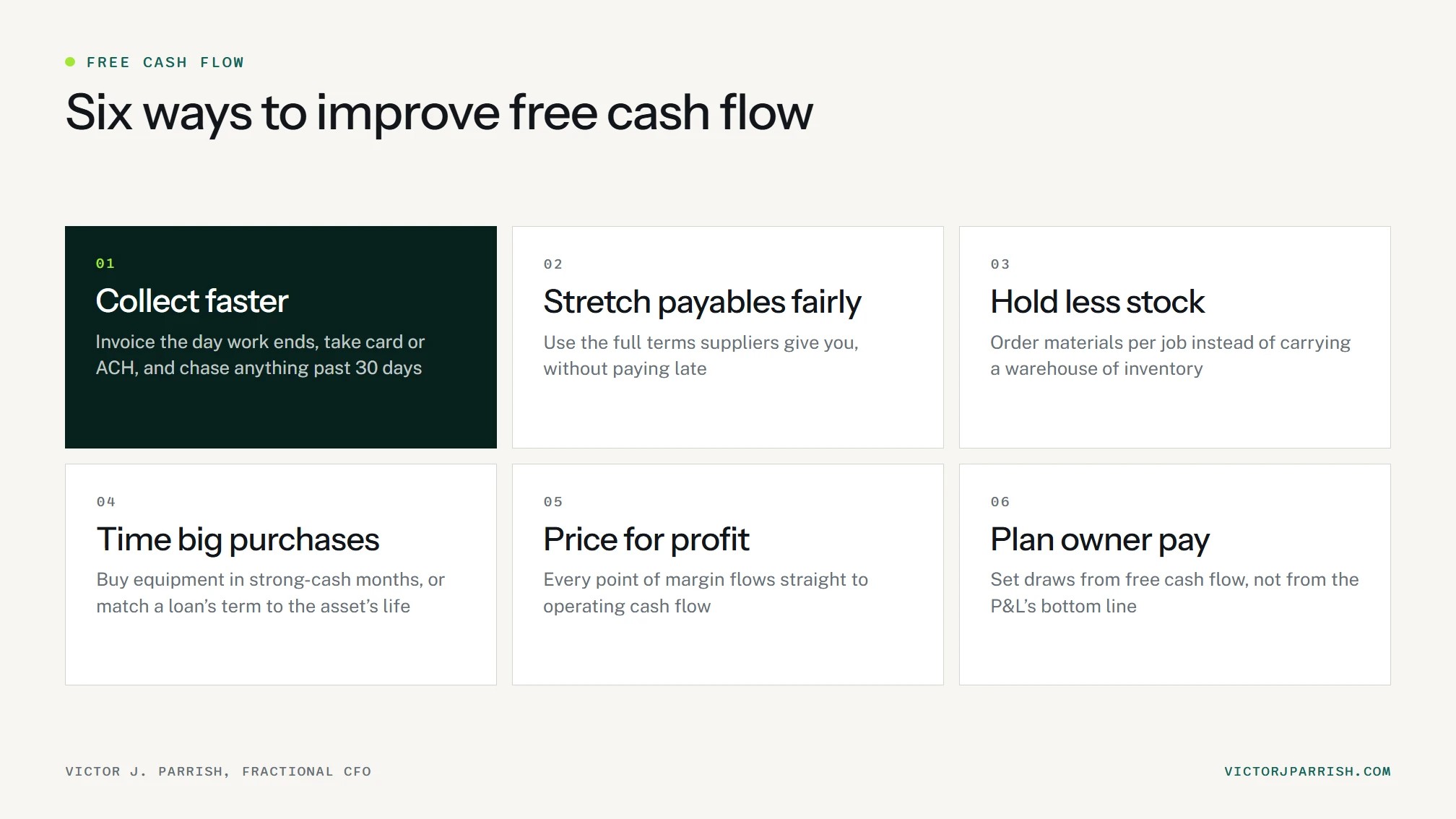
How do you improve free cash flow?
Improve free cash flow by collecting from customers faster, using the full payment terms suppliers give you, carrying less inventory, timing large equipment purchases to strong cash months, raising prices where margins are thin, and setting owner draws from free cash flow rather than from profit.
Working capital is usually the fastest lever. In the example, receivables growth alone consumed $42,000, more than the whole year’s free cash flow. Invoicing the day a job ends and following up at 30 days can free more cash than a price increase. Our guide to accounts payable vs accounts receivable covers both sides of that gap.
Then plan the big purchases. In the Federal Reserve’s 2026 survey of small employer firms, 50% reported uneven cash flow as a financial challenge, and among firms that faced challenges, 54% covered them with the owners’ personal funds (Federal Reserve Banks: 2026 Report on Employer Firms). Equipment bought in a slow month, paid from operating cash, is a common way that happens. A 13-week cash flow forecast shows which months can carry a purchase.
How should you pay for equipment without draining free cash flow?
Match the financing to the asset. Paying cash for a truck that lasts eight years drains one year’s free cash flow to fund eight years of work. Equipment loans, leases or a line of credit spread the cost over the asset’s life, but only make sense when the payments fit comfortably inside future free cash flow.
Jose R. has run a printing and graphics business in California since 2010. His scores were in the 810s and 820s, but his business cards carried 46% to 72% utilization on large balances, and he wanted to raise about $150,000 for equipment and software. The plan set a realistic first-round target of $50,000 to $75,000 and sequenced new applications. He secured $67,400 across five new business cards, which gave him room to move high-interest balances to 0% offers and fund equipment without taking on a term loan.
The lesson for free cash flow: the equipment was going to cost the same either way. What changed was how much of each year’s cash went to interest instead of back into the business. Before you finance a purchase, check that the payment fits inside a normal year’s free cash flow with room to spare. Lenders check the same thing, which our guide to how to qualify for a business loan walks through.
What does negative free cash flow mean?
Negative free cash flow means the business spent more on operations and long-term assets than its operations brought in. It isn’t automatically bad: a growing company buying equipment or funding new receivables often runs negative for a year. It becomes a problem when it lasts and is covered by credit cards, owner savings or short-term debt.
Ask why it’s negative. If the cause is a one-time equipment purchase or fast growth in receivables from good customers, plan the financing and move on. If it’s thin margins, slow collections or owner draws above what the business earns, the fix is operational. Look at your gross profit margin first, then collections. If your business is an S corporation, the salary you pay yourself is already inside net income, but distributions come out of free cash flow; our S corp vs LLC guide explains the difference.
Sources
These are the primary sources used for the figures in this article.
U.S. Securities and Exchange Commission: Beginners’ Guide to Financial Statements
Aswath Damodaran, NYU Stern: Capital expenditures by sector (US), January 2026
Federal Reserve Banks: Small Business Credit Survey, 2026 Report on Employer Firms
This article is general education, not accounting, tax or legal advice. Talk to your CPA about how these rules apply to your business.
FAQ
Frequently asked questions
What is free cash flow?
Free cash flow is the cash a business generates from its operations minus what it spends on capital assets such as equipment, vehicles, buildings and software. It shows the cash available to pay down debt, pay the owners, build reserves or fund growth.
What is the formula for free cash flow?
Free cash flow equals operating cash flow minus capital expenditures. Starting from the P&L, it is net income plus depreciation and amortization, minus the increase in working capital (receivables and inventory less payables), minus capital expenditures.
Is free cash flow the same as profit?
No. Profit (net income) includes non-cash expenses like depreciation and ignores timing, such as invoices customers haven’t paid. Free cash flow counts only cash, and it subtracts the full cost of equipment purchased in the period. A profitable business can have low or negative free cash flow.
Is negative free cash flow bad?
Not always. A growing business that buys equipment or carries more receivables can run negative free cash flow for a year. It becomes a concern when it persists and is funded with credit cards, owner savings or short-term debt rather than planned financing.
Do owner draws reduce free cash flow?
No. Free cash flow is calculated before owner draws, distributions and loan principal, which are paid out of it. If draws and principal are larger than free cash flow, the business’s cash balance falls even in a profitable year.


